|
| Enjoying the cool breeze and view owhite rann at sunset time |
 |
| Our Bhunga at night |
The tour of Kutch region continues
from Bhuj to Rann of Kutch. Having seen most of the land marks of Bhuj, we
started next day by road to Rann of Kutch by 6 am, because we wanted to see the
art and craft village “Nirona”, (one of the amazing example of mundane village
life and tribal art converted to tourist attraction and artifact collection
center), and reach Dhordo by lunch time, else would have risked hunger pangs
till teatime. My camera started playing tantrum and clock went haywire in White Rann. If that is the effect on camera. So in some pictures the time is not correct. Author regrets this.
Nirona is almost an hour journey
from Bhuj. We had breakfast at a roadside eatery, serving piping hot Dosa, Urd
Dal vada, sambhar and finger licking chutney. What we look in these eateries is
hygiene, and yes it was spick span, serving food in well cleaned utensil,
bottled water and freshly cooked food. After eating a sumptuous breakfast and
filter coffee we proceeded for Nirona.
Nirona village looked like any
other village of India, cluttered with houses, un-asphalted road but very neat,
clean place with very polite and smiling inhabitants. Our guide took us to the
house of Khatri’s, a family proficient in Traditional Rogan Art. This form of
painting is almost 300 yrs. old and is done by a single family in whole of
India “The Khatri Family”. Gafoorbhai Khatri revived this dying art and made
sure all family members learn it, so that that the mistake done by earlier
generations, due to which it almost disappeared, is not repeated again.

A delicate art form, Rogan art
requires making Rogan from castor oil, making colors diligently at home. This
painting is done by drawing thread of paint by a 6 inches iron rod and making intricate
designs using just fingers and rod holding the color thread. An amazingly beautiful
art but expensive. These paintings are
surely collectors’ items. US President Mr. Obama was presented Rogan Art’s
Kalpataru painting by Indian Prime minister Mr. Narendra Modi. Gafoorbhai is a
national award winner and teaches children of village this art hoping one day
one more family will take to this art. He does not market his product from any outlet
except his house. For more detail information all art lovers can go the Web : www.traditionalroganart.com or contact him by e-mail traditionalroganart@gmail.com.


Next was the house of a family
making chimes and other artifacts from copper, These families used to make
bells for cows and other herd animals in earlier days but now they have moved
ahead in life to create beautiful artifacts using their experience. They are
always happily willing to give demonstration to the visitors. The chimes are
very intricate in design and are from tiny to large size, some even creating
notes of Indian music. We purchased few of these items as they were affordable,
not too expensive.

The ladies do embroidery and glass
work which are really eye catching and showcase the tradition of the village.

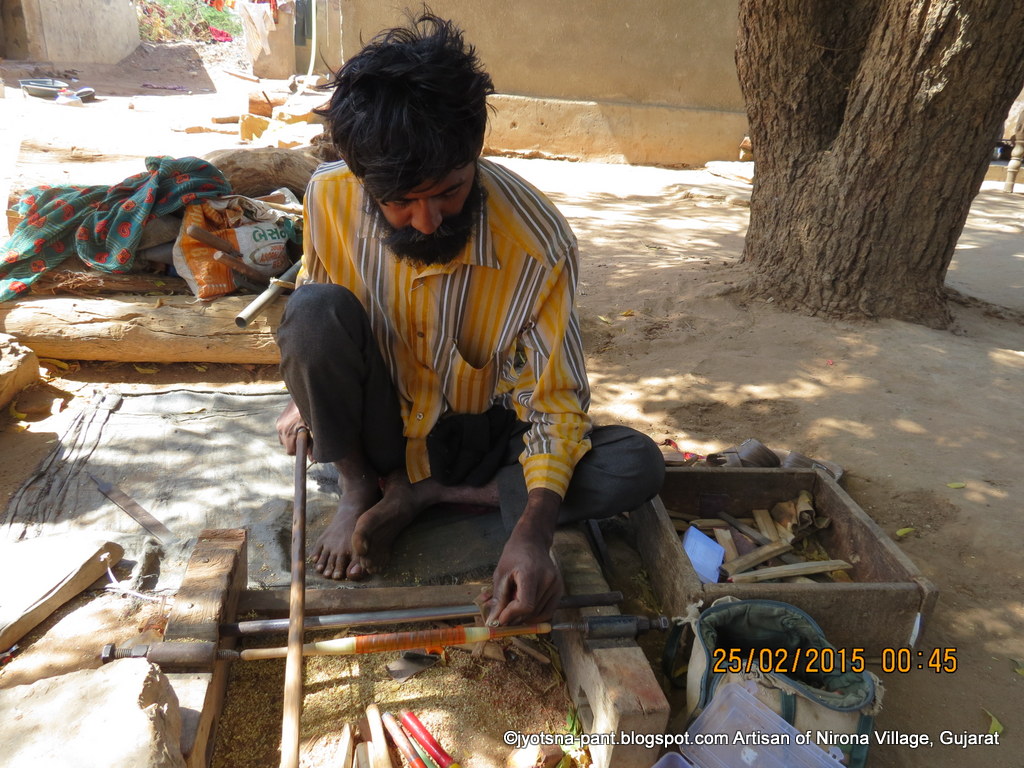
Lastly we went to a poorest
looking area, here wood work using traditional tools was being done and
coloring was done by natural pigment collected by the family patriarch, as they
have the experience to how and when collect the pigment. Amazing knowledge of
nature these people have got. I did purchase few rolling pins and ladles.

Though they have an opening now to
sell their wares in Kutch festival, and to tourist coming to their village,
they yet require some marketing and business experts to help them in their
business. Hope one day they see their business flourishing.
From Nirona it was a long journey
to Kutch, there are no shops, hotels on the way, so best is to pack some food
and water. It was pretty arid with rare green patches here and there. Our guide
told us rain is good only once in two years. We saw some amazing whirl winds,
blowing the dry soil like a cone, but none was big enough to cause danger. Mid
way to Dhordo, pass has to be taken from authorities for the entry and stay.
On entering our resort Gateway to
Rann at Dhordo we were flummoxed by the luxurious bhunga (place to stay as it
is called in local language) in hut form made using maximum natural resources.
This is a place to see modernity in association with nature. The decoration of the
reception hall is done using traditional natural pigment in local art form. The
resort was made by Gujarat Govt. and made into a trust then handed over to the
Dhordo village for running it smoothly. Local people got jobs, and government
interference got eliminated. Spotlessly clean, well maintained, four sumptuous
vegetarian meals are served. This place I could have stayed for days together.
Apart from Gate way to Rann there are other resorts equally beautiful.


After resting we headed to see the
Desert!!!
But I find no sand. Where is the
desert? Oh look ahead it is not the usual sandy desert but Salt desert. It was
a stunning view, just breath taking view. I just stood there to gape at the
marvel of nature. It was whiteness spread everywhere, look left; look right or
look just straight ahead it was salt, salt and salt. I could have never
imagined in my wildest dream also that the great beauty salt holds in
beautifying the nature. For me till then salt was an important ingredient of a
savory dish.
The sun was not yet set so the
white sunlight was making the salt shine like pure silver.


There were local
artists playing Guajarati folk music and singing melodies. Colorfully decorated
camels were dotting the salt desert. We preferred to explore the area on foot,
like hordes of other people.


As the sun started moving towards
the horizon, the color of the salt started changing from white, to golden
color. I was awestruck with the pure golden hue of the salt.


Camera focused on
the sandy desert we waited with baited breath for the next moment, when sun
dips little further and gets a red hue. Lo and behold the whole area turned to
red and orange shade as if some magic had occurred. Or as a second thought is
it not magic of nature? We may make wonderful, amazing wonder of the worlds but
nobody can even mimic this marvelous magic of nature. Why I say this? Well wait
for a moment for I am enjoying the orange red hue to change and surprise me
further.
The sun started moving down the
horizon and the salt desert started getting darker shades of red, almost blood
red color. I even forgot to take photograph at this moment because I did not
want camera to come in between me and nature. Finally the sun started to
disappear from the horizon and darkness of very dark shade of red, and then
complete black spread around. But at this moment also the salt seems to be
saying “Even the night cannot make me completely black I will retain my shine
in every hue and color.


In this dance of colors of setting
sun on salt we completely forgot the east side of desert! Wow! Wow! Wow! The
moon had risen from east and the soft-golden-light of moon was making the east
side of salt to shine like pure gold. It was pure magic of nature (Yes I am
guilty of repeating myself. But nature’s magic is pure magic no other name for
it). West side of desert almost black, east side shining with soft golden hue,
no camera can capture with complete purity this marvelous aspect of Rann of
Kutch, except the eyes. I kept on looking from my right to left and left to
right, till my neck started protesting and husband started dragging me off to
the waiting taxi. I promised myself I will come here tomorrow again to take
some photographs. It gives me an unexplainable pleasure even now, when I think
of that place.
Back into the bhunga we freshened
up and were going for dinner when we heard the melodious music and songs sung
by music troupe of the village. Some of their instruments were a part and
parcel of their heritage and culture. Ghado, Ghamelu, Morchang are some of
them. Ghadu is earthen pot rest are metallic. Some are used as domestic pots as
well as musical instruments. They are made by the artisans of the village in
such a manner that their sound can be heard till 1km. without sound enhancement
system. We thoroughly enjoyed the folk music and songs. It was the time for
dinner and siesta, for next day was another busy day.
 |
| Music Troupe In Gate way resort |
We started early in the morning
for Kalodungar.
On the way to Kalodungar we saw local people making Khawa (Concentrated semi dry milk) from their dairy produce. I must compliment the people of Gujarat for their maintenance of cleanliness and hygene.
 |
| Khawa being made |
The name of this place is derived from the fact that the hillocks were bereft of trees so the color
of soil used to give it black (Kalo in Gujarati) hue, thus the name Kalodungar.
Now it is no longer pure Kala (Black). Gujarat govt. has gone on plantation drive
and you can see greenery around, yet the soil color does give the black color to hillocks, as if justifying the name. The view of salt desert is yet beautiful from
here. We were told by the BSF personal staying there that sunrise and sunset
give amazing view of desert from there. May be next time I replied.


I do not know of the scientific
reason but almost 300 meters on the way to Kalodungar the vehicles move even
uphill without accelerating, they just get pulled up and push on the way downhill.
May be due to some strong magnetic substance and magnetic field present there.
It was thrilling to be in a car with driver sitting cross legged on the seat
and the car being pulled up by some unseen force. We realized Kalodungar
requires whole day to explore. Maps are displayed for benefit of visitors and
as usual they try to keep the place very clean, despite of visitors littering
the place with plastic bags and left overs.

Government of Gujarat makes sure
children know about the heritage and history of Gujarat, thus in vacations
school trips are arranged. One such group was sitting with their teachers,
listening with rapt attention the lecture BSF personal was giving, imparting
knowledge about the place, it’s historical and present day geopolitical
importance. The best thing I liked was that when he asked “What is Pakistan to
you all”, children replied enemy. He was quick to rectify them and said
Pakistan is our neighbor not enemy. Catch them young to teach correct things
are his moto. We were in also audience and thanked him for the excellent work
which he was doing out of the line of his regular duties.


After darshan in the temple we
started our trip back to Dhordo else we would miss our lunch and so would our
driver.

Another visit to salt desert and a
night full of music and dance we went to our bhunga for a good siesta. Rann of
Kutch opens for visitors from October to march end. When the tide brings water
the salt desert submerges under water to resurface in September.
After once in a life time
experience in Dhordo, we will be heading back to Bhuj and after checking into
hotel immediately to Mandavi another historically important and beautiful
place.